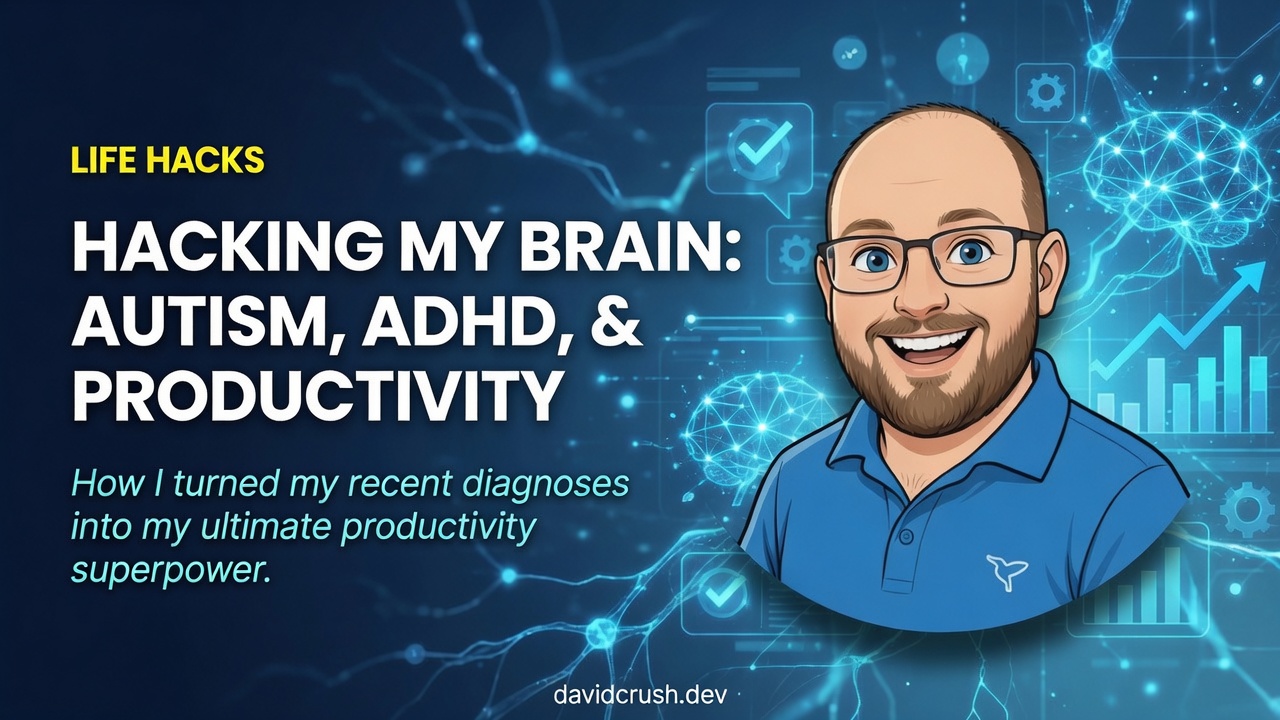
It happened. I got my diagnosis and in a weird way it’s actually like a huge weight has been lifted off of my shoulders. I’ve learned a ton how my brain works and what does and doesn’t work for me. That’s allowing me to start to hack my brain for even more productivity.
First off, I have to say, I’m truly doing better. I don’t say those words lightly. After so many years of struggling and not knowing why. Not understanding why I’m burning out. Neurodivergents, we march to the beat of a different drum. Strategies that work for others don’t always work for us. I get it now.
It’s hard for me to remember a time where I have felt this good about the future. I know it’s not instantaneous. I have a lot of work laid out in front of me. But the path is clear. I’ve been dreaming of clarity like this for years. I’m very fortunate to have gotten it.
Okay, so let’s talk about strategies I’ve learned and how they’re helping:
- Pomodoro Technique - This is a technique unique named for the tomato (fun story, the guy who invented it was using one of those tomato timers hence the name) that essentially boils down to breaking down tasks into timed intervals. Where this has really helped me is I’m the type of person that can spend 10 hours working on a problem and not even realize. Next thing I know the whole day has gone by and I haven’t even eaten. This forces me to take those short breaks. And another thing I was struggling with was context switching. I’ve found for me about 30 minutes is enough to make meaningful process on a problem. So I work for 30 minutes, take a 5 minute break. If I want to context switch after the break, that’s fine. But this at least requires us to spend enough time to make some meaningful progress and stuck in the endless context switch where nothing gets done. It’s such a simple technique but it’s having a huge affect on me
- Think it Through - I’m describing a rough idea of a technique here but I essentially classify it as the “think it through” method. Which just means think out the logical and realistic outcomes and what they mean and what we can or cannot do about them. The problem is my mind loves to spiral. I’m very much like an LLM. In the abscense of data, I tend to hallucinate and fill in the blanks. It’s like mad libs but my brain. And I also have a tendency to fill in the blanks with bad things. This is like feedback loop that causes me to keep thinking of worse and worse scenarios, no matter how illogical they may be. The fix is also quite simple, when you have those negative thoughts, you need to think rationally and logically about the situation. Things can go bad. It happens. What we must focus on is what we can control in that situation, not the imaginery scenarios we have invented. Being able to classify your thoughts between rational and irrational is an important skill and I’m getting much better at it. But this is the way you can take an anxious thought or moment and prevent it from escalating into a full panic attack.
- Cold Splash of Water - I’m not even sure how to describe this one other than what it is, it’s a cold splash of water in moments of overwhelming anxiety. I can actually feel my body working its way up to a panic attack. It’s like a slow rush over my whole body. Once we can identify this is what is happening, if we can put our hands in cold water, splash some on our face, even dunk your head in some cold water, this provides like a reset on your system. I’m going to use an analogy, this is like networking in computing. For example, in our home we have a mesh router. Sometimes I can start to tell when our ISP is about to go down, I see slower speeds and lost packets. Whenever I notice this the first thing I do is go unplug the modem, wait 10 seconds, plug it back in. I do the same to my body. I start to feel the panic setting in, cold water provides a reset. It’s like tricking your body via distraction. And it actually works. I was skeptical when I first heard this one but I’m a believer now.
There’s many more techniques out there, I’m just scratching the surface but I’m nerding out on this. I love efficiency. I like to pride myself on doing more with less. This is like opening up so many doors for improving productivity that I never knew existed. I’m ready to adapt my style to my brain. The future is looking bright. I have a lot of hard work ahead of me but I don’t mind hard work. God is good.